Industry take · Fresh operations
India's festive quarter is won before it begins
India's celebration season is not one national demand spike. It is hundreds of hyperlocal ones—and for fresh-commerce operators, readiness becomes a moat long before the first order lands.
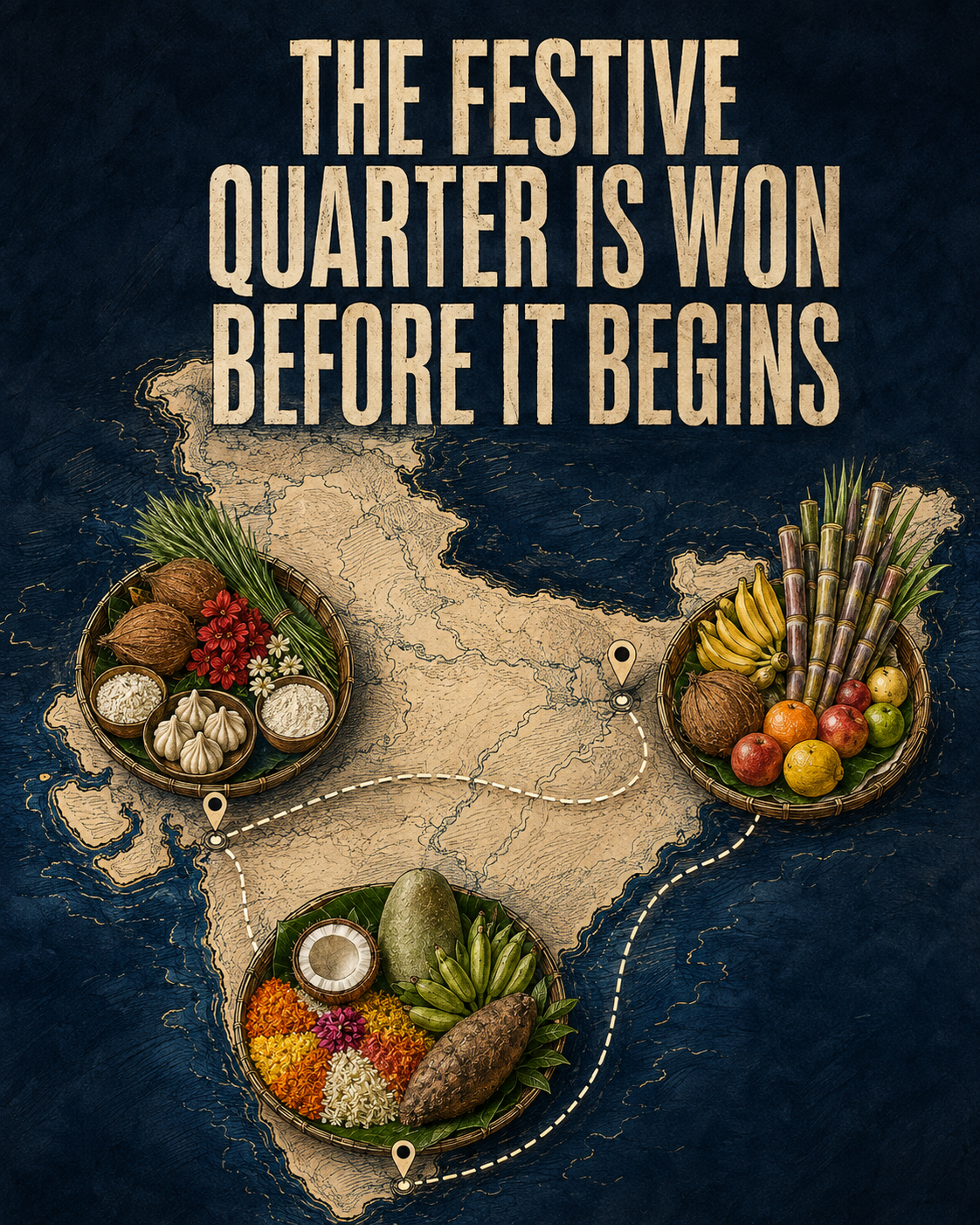
From the outside, late August can look like the calm before India's festive quarter.
From inside a fresh supply chain, it is the deadline.
I have spent ten years in fresh operations, and this is the season I respect most. By the time flowers, fruits and festive ingredients appear as orders on an app, most of the decisions determining whether they arrive fresh—or arrive at all—have already been made.
Demand has been forecast. Vendor capacity has been committed. Packaging specifications have been agreed. Quality tolerances have been set. Inventory has been distributed across cities and dark stores.
If those decisions are wrong, ten-minute delivery cannot rescue the customer experience.
One season, hundreds of demand curves
From Onam and Raksha Bandhan through Janmashtami, Ganesh Chaturthi, Navratri, Durga Puja, Dussehra, Diwali and Chhath—and onward to Gurpurab, Christmas and New Year—India enters an almost uninterrupted season of celebration.
For fresh-commerce operators, this is not one national festive spike. It is hundreds of hyperlocal demand curves overlapping across cities, communities and pin codes.
Consider four baskets within a few weeks of one another.
In Kochi, Onam demand includes banana leaves, pookalam flowers and the vegetables required for a sadya—raw banana, yam, ash gourd, cucumber, coconut and several other ingredients. A traditional sadya can contain more than 20 dishes, creating demand across an unusually wide fresh assortment.
In Mumbai, Ganesh Chaturthi shifts the basket towards fresh durva grass, red flowers, coconuts, milk, jaggery and ingredients for modak. This is not necessarily a single-day peak: daily worship throughout Ganeshotsav can create repeated demand.
In Ahmedabad, Navratri brings increased demand for fruits, flowers, coconuts and ingredients used in vrat meals.
Come November, a household in Patna preparing for Chhath may need sugarcane, coconuts, bananas, citrus and other seasonal fruits for offerings made during a tightly defined ritual window.
All four are fresh baskets. Operationally, they have almost nothing in common.
The assortment changes by festival, region, community, pin code and sometimes even time of day. That is the central challenge of festive fresh operations: national scale has to be delivered through local understanding.
The unit of planning is not the SKU
Traditional retail planning begins with categories, SKUs and cities. Festive fresh planning requires a different unit:
Occasion × pin code × time window.
The same coconut may appear in several festive baskets, but the surrounding mission changes.
For Onam, it may be one ingredient within a much larger meal-preparation basket. For Ganesh Chaturthi, it may be part of a puja requirement. During Navratri, it may sit alongside fasting ingredients and fruits. At Chhath, it may be selected for its suitability as an offering.
This distinction matters because the customer is not merely purchasing products. The customer is trying to complete an occasion.
A conventional availability report may show that 95% of the relevant assortment is in stock. But if the missing 5% contains the defining ingredient for the ritual or meal, the customer's mission is still incomplete.
That is why festival operations need to measure more than item availability. They need to measure occasion completion.
Could the customer complete the puja, prepare the meal, observe the fast or make the offering with the basket that was available?
That is a much harder—and more useful—question.
Perishability makes the problem unforgiving
A packaged product can often be moved between locations or stored for the next demand cycle. Fresh products offer less room for error.
Flowers wilt. Leaves tear. Durva loses freshness. Fruit bruises. Dairy faces temperature risk. Banana leaves require careful handling and significant storage space. Sugarcane is bulky and operationally inconvenient.
The quality expectation also changes with the occasion.
A fruit that remains perfectly suitable for cooking may not meet a customer's expectation for a ceremonial offering. A flower garland that is technically sellable may not remain fresh through the customer's puja. The wrong leaf cannot be replaced by another green SKU simply because both sit within the same merchandising category.
Substitution rules must therefore be culturally informed. Some products can accept a variety or size substitution. Others should be marked as “no substitution.” In some cases, the correct operational decision is to show the item as unavailable rather than deliver something that fails the customer's purpose.
What festive readiness actually takes
Excellent festive execution begins weeks before demand becomes visible on the app.
1. Forecast the occasion, not just historical sales
Last year's SKU sales are only a starting point. Demand models should also consider festival dates, weekdays, local community concentration, customer searches, past out-of-stock behaviour, weather and ritual timing.
A city-level forecast is insufficient when two neighbouring pin codes may have very different festival baskets.
2. Reserve vendor capacity before the market tightens
Fresh supply cannot always be created after demand appears. Flower cultivation, fruit harvesting and regional produce availability may have been determined months earlier. By the time wholesale prices rise, the best supply may already be committed.
Critical products need advance capacity reservations, secondary vendors and alternative supply routes.
The real sourcing question is not, “Can the vendor supply coconuts?” It is: “Can the vendor supply the required grade and volume, across the required locations, within the receiving window—and what happens if the first lot fails inspection?”
3. Design quality standards for the occasion
Festive demand should not cause quality checks to become more lenient. It should make them more precise.
Flowers may need standards for bloom, colour and remaining life. Banana leaves need size and tear tolerances. Fruits intended for offerings may require different cosmetic grading from fruits intended for cooking.
4. Protect the defining products
Not every item in a festive collection is equally important. Operators should distinguish between:
- Non-substitutable ritual essentials
- Core meal-building ingredients
- Fresh products with acceptable regional substitutes
- Convenience additions
- Gifting and impulse products
Availability should be protected in that order. If additional inventory has to be positioned somewhere, it should first support the products whose absence would make the entire occasion incomplete.
5. Merchandise the mission
Customers do not necessarily know the retailer's category structure. They know they are preparing an Onam sadya, setting up Ganesh puja, observing a Navratri fast or arranging Chhath offerings.
Merchandising should reflect those missions. It also means recognising that Navratri in Ahmedabad, Durga Puja in Kolkata, Bathukamma in Hyderabad and Golu in Chennai may occupy a similar calendar window without sharing an identical basket.
The opportunity is real—but it is not the whole prize
Quick-commerce order volumes grew by more than 85% year-on-year during the opening week of India's 2025 festive sales, according to a Unicommerce analysis reported by Business Standard.
That makes festive readiness commercially important. But the incremental basket is not the biggest prize.
Imagine a customer realising at 7 a.m. that the puja still needs durva, betel leaves or a coconut. The family is ready. The ritual has a fixed time. The local market may not yet be accessible. There is little room for a second attempt.
If the correct product arrives fresh and on time, the platform has done more than complete an order. It has kept a promise during a moment that matters.
The monetary value of that basket may be modest. Its emotional value is not.
A moat built festival by festival
Discounts can be copied. Delivery times can converge. A competitor can add the same broad category to its app.
What cannot be assembled overnight is the operating knowledge required to understand that a particular pin code needs a particular flower, fruit, leaf or vegetable—in a specific condition, at a specific hour, for a specific occasion.
That knowledge compounds. It lives in historical demand patterns, vendor relationships, quality specifications, regional merchandising, substitution rules and the judgement of teams that have handled previous festive cycles.
Repeated across festivals, cities and communities, operations becomes more than a fulfilment function. It becomes cultural intelligence. It becomes supplier capability. It becomes customer understanding.
Most importantly, it becomes accumulated trust.
India's biggest retail quarter is not won when demand reaches its peak. It is won in the weeks before the spike begins.
Cultural references: Onam sadya, Ganesh Chaturthi, and Chhath Puja.